


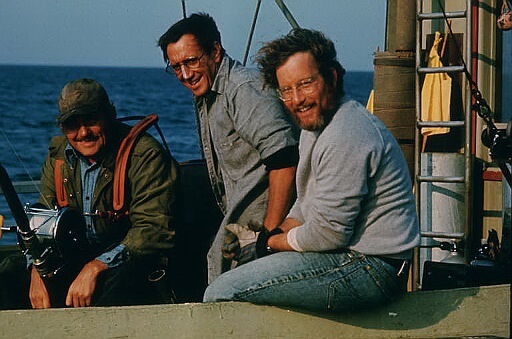
50 years ago on June 20, 1975, Universal Studios released Jaws, a film about a great white shark terrorizing the fictional beach community of Amity Island, creating the very first summer blockbuster. And it was all due to the vision and talent of a young director named Steven Spielberg.
Jaws, the film that scared people out of the ocean and into the movie theaters, is celebrating its 50th anniversary this year. As part of the summer-long celebration, the PG-rated thriller is returning to the big screen for a Labor Day weekend run beginning August 29, 2025.
Before celebrating its return, let’s examine just how the summer blockbuster about a man-eating shark and those trying to stop it came to be. It was 1973 when movie producers Richard D. Zanuck and David Brown purchased the rights to Peter Benchley’s novel Jaws before it was published. They were extremely impressed with the manuscript, which they read in a single night, so they took a chance and quickly secured the rights to adapt it into a feature film.
Their first choice for a director of the film, Dick Richards, didn’t work out due to the fact he kept calling the shark a whale, which upset the producers and Peter Benchley. Realizing he wasn’t going to work out, Zanuck and Brown started a search for a new director. Word reached them that Steven Spielberg was very interested in helming the film. Zanuck, Brown, and Spielberg met with Benchley, who appreciated that Spielberg understood what his novel was about and liked his take on it.
Now, the search was on to cast the three male leads of the film. Many names were thrown around, including Lee Marvin, Jon Voight, Timothy Bottoms, and Jeff Bridges. Spielberg met with Richard Dreyfuss, hot off the George Lucas hit film American Graffiti and offered him the part of Matt Hooper, the young oceanographer and shark expert. Dreyfuss turned it down, telling Spielberg that the film sounded like a b*tch to shoot. However, after seeing his performance in The Apprenticeship of Duddy Kravitz and thinking he’d never work again, Dreyfuss called Spielberg and begged him for the part.
It was at a party that Spielberg found his Police Chief Martin Brody when he met Oscar-winning actor Roy Scheider. Spielberg was depressed about the casting process and Scheider just happened to ask what was wrong. Spielberg described the plot of Jaws and the character of Chief Brody, and Scheider suggested himself for the part.
To play Quint, the grizzled shark hunter, Spielberg originally wanted Lee Marvin but he quickly turned it down, having no interest in the role. Next, he wanted actor Sterling Hayden, who played the corrupt police captain gunned down by Al Pacino’s Michael Corleone in The Godfather. However, Hayden also turned down the role. Zanuck and Brown stepped in and suggested Robert Shaw, who they had worked with on The Sting. Shaw accepted the role, rounding out the principal cast.
Spielberg decided to throw out all the side stories in the novel—how the mafia forces the mayor to keep the beaches open and the affair Hooper has with Brody’s wife—and streamlined it to a simple man-against-beast story.
The filming turned into a very real nightmare for the cast, crew, and director. Spielberg decided to shoot the movie on the ocean off Martha’s Vineyard, but the salt water was brutal on the parts of the mechanical sharks built to be the titular Great White. Many filming days were lost due to the shark not working.
In an interview on The Rachael Ray Show, Dreyfuss shared an interesting behind-the-scenes tidbit. “You could follow the progress of the film by the amount of radio mics there were all over the island, right, even if you didn’t care. And you heard, ‘The shark is not working. The shark is not working.’ The shark never worked, and Steven Spielberg had to reconceive the film because the shark never worked.”
Spielberg decided to film as many scenes as he could without showing the shark, which turned out to help add to the suspense and tension of the film. Ultimately, Bruce, the crew’s nickname for the mechanical shark after Spielberg’s lawyer Bruce Ramer, started working. The cast and crew worked through the summer and finished over budget and behind schedule in October 1974.
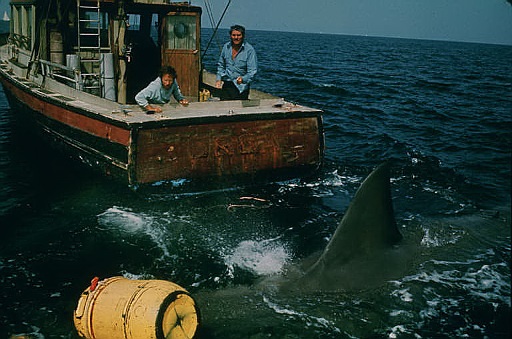
The script was also an issue, going through rewrites and having scenes added late in the process. One particular stroke of genius was Spielberg wanting to give Quint a reason for his obsession with hunting and killing sharks. Howard Sackler, an uncredited writer, came up with the idea of Quint being a survivor of the USS Indianapolis disaster. Sackler wrote the first version of the speech, but it was too short and he wouldn’t expand on it. Spielberg asked John Milius to work on it, and he wrote a much longer version that felt like it was too much. Robert Shaw, who was also a published author and playwright, took the drafts of the monologue and wrote his own version. Shaw’s version is the one used in the movie, and the Indianapolis monologue is the emotional centerpiece of the film. As Spielberg told Vanity Fair, the monologue is Shaw’s version of Milius’s version of Sackler’s version.
It was just two notes—a “figuration based on a semitone of E and F,” per The Legacy of John Williams—that became one of the most memorable and terrifying film themes in history. American composer and conductor John Williams had worked with Spielberg on his film The Sugarland Express, and Spielberg believed he was perfect to write the musical score for Jaws. Williams said in an interview that he saw the main theme of Jaws as an embodiment of the shark itself. The simple notes could be manipulated to slow down or speed up as the Great White hunted. The result was an iconic piece of music that was simple, driving, and unstoppable, just like the attack of the shark.
However, when Williams first played the main theme for Spielberg, the director thought Williams was joking. “I thought he had a great sense of humor and he was putting me on. And he said, ‘No, that’s the theme to Jaws!’ I said, ‘Play it again,’ and he played it again and again… and suddenly it seemed right. John found a signature for the entire movie,” explained Spielberg on a DVD featurette.
Jaws grossed more than $7 million over its opening weekend. It went on to break all the box office records at that time, ringing up $260+ million domestically during its first run to become the highest-grossing film, a record it held until Star Wars’ release in 1977. It was also the first movie to earn over $100 million domestically and won three Academy Awards: Best Film Editing, Best Original Score, and Best Sound.
The 50th anniversary re-release will screen in 4K, IMAX, RealD 3D, 4DX, and D-BOX, making it the perfect time to relive the thrills of the first-ever summer blockbuster in theaters. The bigger the screen, the better.
The post ‘Jaws’ 50th Anniversary Celebration: The First Summer Blockbuster Returns to Theaters appeared first on ShowbizJunkies.


0 Comments